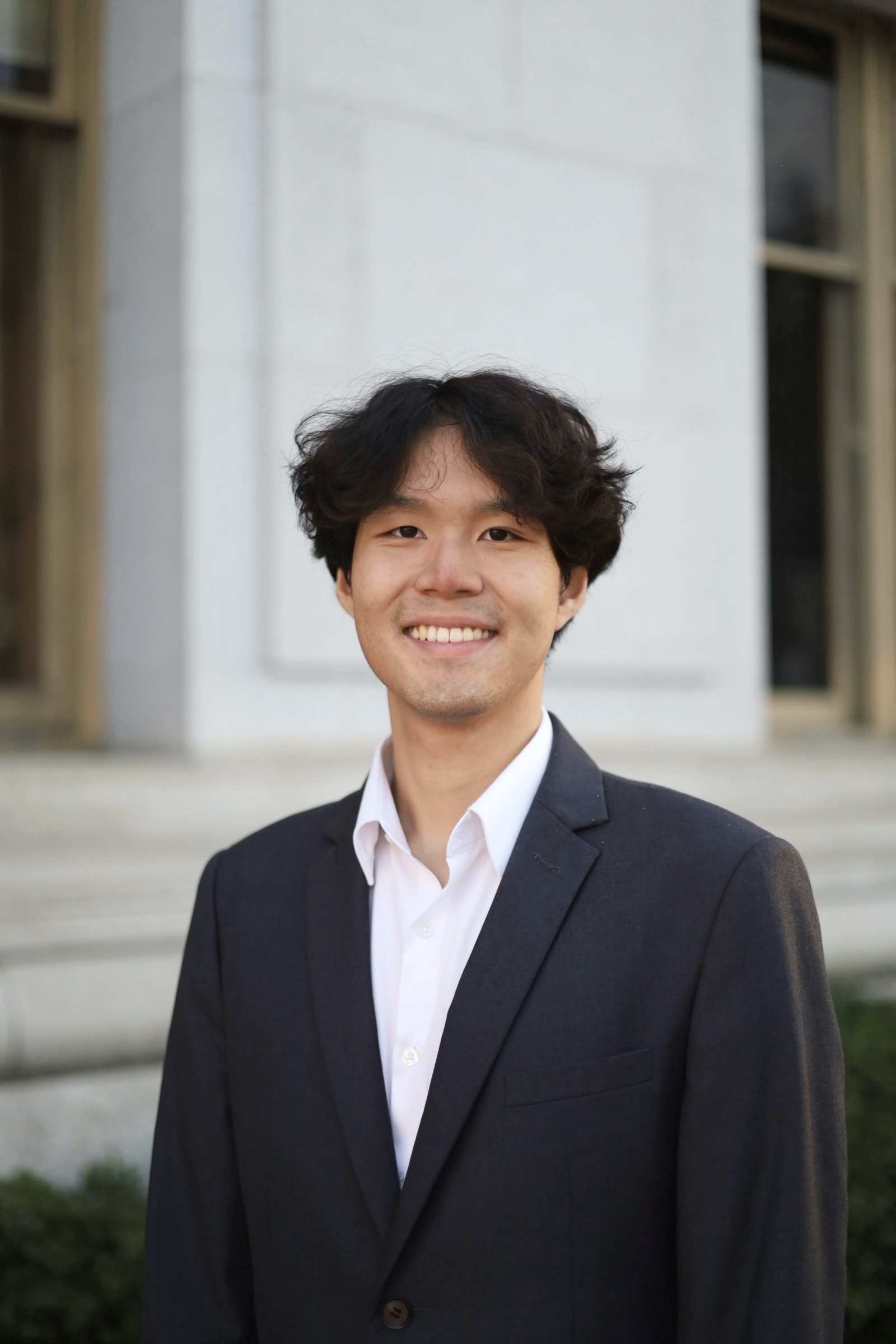
Welcome! I’m Kenny

I’m a rising senior at the University of California, Berkeley, majoring in Industrial Engineering & Operations Research (IEOR) and minoring in Data Science & Mathematics. Using tools from Operations Research, Data Science, and Applied Economics, I am broadly interested in three research directions at the intersection of Operations Management, AI, and data-driven decision-making:

Data-Driven Service OperationsInformation and market design in service systems with strategic interactions.

I study the design of dynamic service systems in which information is asymmetric and participants respond strategically to prices, incentives, and system conditions. I combine tools from stochastic optimization, game theory, and empirical methods to model and analyze operational decisions, focusing primarily on public-sector problems such as urban transportation, as well as pricing and matching in online platforms.

On the application side, I developed dwell-time allocation policies for San Francisco Bay Area Rapid Transit (BART) that helped improve throughput on its Yellow Line while accounting for strategic passenger arrivals. I also helped design Calyber: A Ridesharing Game (2025 INFORMS Case Competition Runner-up), a case study deployed in a graduate-level supply chain course at Berkeley, where students develop dynamic pricing and matching policies for a Chicago ride-hailing company.

I believe research can and should extend beyond theory. I am particularly interested in designing and improving routing and matching systems across logistics, transportation, marketplaces, and exchanges because they shape how people, goods, and resources are allocated. Looking ahead, I hope to collaborate with practitioners and policymakers to translate my research into socially impactful solutions to real-world challenges.

Frontier and Limits of AI in OperationsWhat is AI capable of in operations, and where does it fall short?

I investigate the reliability of generative AI in high-stakes decision systems. My recent work (AAAI 2026) empirically audits the limits of LLMs in chronological reasoning, with implications for mitigating lookahead bias in forecasting tasks.

As AI capabilities advance, I believe interdisciplinary research on how AI augments human judgment will become increasingly important. Models can be seen solving complex, well-specified problems, but they cannot yet determine which questions are worth asking, which assumptions matter, or how technical decisions will affect people. In my recent talk (Research Perspectives on the Capabilities, Limits, and Future of AI), I explore these questions and their future implications for the field.

Human–AI OperationsAllocating work across humans, autonomous models, and AI assistants.

I study how firms should optimally design workflows and allocate tasks among humans, autonomous models, and AI assistants given differences in their capabilities, costs, speeds, and reliability. In CentaurBench, I show that a model's ability to automate a task is distinct from its ability to assist another agent: some frontier models excel at automation but perform poorly as assistants. These findings highlight the need to benchmark models for the roles they play within a workflow, not just their standalone performance.

More broadly, I view integrating intelligence into enterprise workflows as a multifaceted operations problem, and not just a model selection problem. Tasks arrive dynamically and must be matched to heterogeneous agents whose performance may vary with workload, context, and time. Through the lenses of operations management and operations research, I hope to formalize and optimize these complex, evolving systems.

In summer 2025, under the Columbia Business School’s Summer Research Internship program, I was a visiting research fellow collaborating with Professor Paul Glasserman of Decisions, Risk, and Operations (DRO). At Berkeley, I am fortunate to work with and be advised by Professor Chiwei Yan at the Department of Industrial Engineering & Operations Research, Berkeley College of Engineering, and Professor Abhishek Nagaraj, at the Data Innovation & AI Lab (DIAL), UC Berkeley Haas School of Business. I am also privileged to work with Professor Phillip Kerger to design and teach various Berkeley courses, including Foundations of Machine Learning for high school students through Berkeley GLOBE.

My Curriculum Vitae can be found here.

🎤 Upcoming Talks

  • Nov 2026INFORMS Annual Meeting, San Francisco, CA
  • Sep 2026Wharton Generative AI & Business Conference, San Francisco, CA

📢 News